
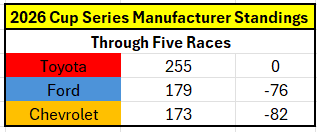
With Denny Hamlin’s win at Las Vegas Motor Speedway on Sunday (March 15), Toyota continued its strong start to the 2026 NASCAR Cup Series season. All told, Toyota has won four of the first five races of the campaign, albeit three of those came courtesy of Tyler Reddick. In the manufacturer standings, Toyota leads Ford by a healthy margin of 76 points. Ford has one victory this year, which came when Ryan Blaney prevailed at Phoenix Raceway.
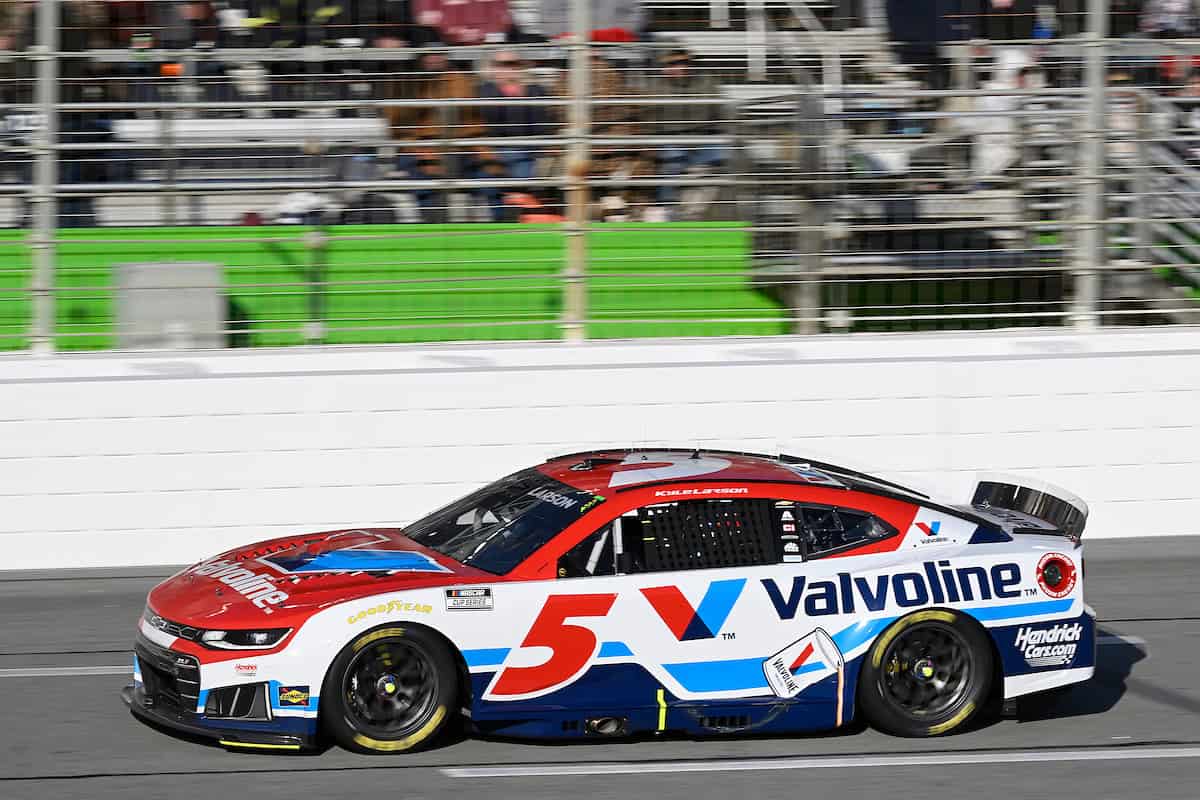
Then, there is Chevrolet. The five-time defending manufacturer champion that is so accustomed to Cup Series success has yet to find victory lane in 2026 and currently sits last in the manufacturer standings.

In the Chase/Playoff Era (2004-present), Chevrolet has gone winless through the first five races of the season just two other times: 2009 and 2019. In 2009, Jimmie Johnson got Chevy back in victory lane the very next race at Martinsville Speedway. Johnson went on to win his fourth Cup championship that year, and Chevy rebounded to win 18 of the 36 races and the manufacturer title.
In 2019, on the other hand, a Chevrolet driver did not pick up a win until the 10th race of the season when Chase Elliott won at Talladega Superspeedway, one of just seven wins for the manufacturer that year. Chevrolet is certainly hoping not to repeat that performance in 2026.
Now, let’s take a deeper dive into the side-by-side stats for the three Cup Series OEMs through five races:
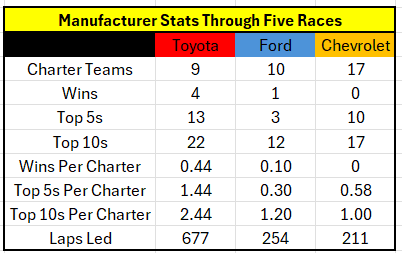
For a manufacturer that boasts nearly half of the full-time teams in the Cup Series, Chevrolet is clearly trailing Ford and Toyota in multiple categories, particularly wins, top 10s, and laps led. While Chevy has more overall top 10s than Ford, the bowtie is behind the blue oval in Top 10s per charter team and has fallen way behind Toyota across the board.
Also, a further breakdown of the data indicates that Hendrick Motorsports is carrying the Chevy camp on its back. The HMS triumvirate of William Byron, Kyle Larson, and Elliott account for four of the 10 top fives, eight of the 17 top 10s, and 152 of the 211 laps led by Chevrolets so far in 2026. While it makes sense that HMS is the lead Chevrolet team, the fact that its drivers possess such a lion’s share of the production should be a concern to fans of the bowtie.
So why the downturn in Chevy performance to begin 2026? Well, Chevy racecars have changed significantly from 2025.
On November 14, fresh on the heels of a fifth straight manufacturer title as well as a driver’s title with Larson, Chevrolet announced changes to the body of its Camaro ZL1 Next Gen cars. The notable changes from the previous Camaro ZL1 include a larger hood dome, revisions to the front grille and redefined rocker panels.
Whenever a manufacturer makes wide-sweeping changes to its racecars, a dip in performance sometimes follows, and such is the case for Chevrolet so far in 2026. As the season progresses and teams gather more data and get adjusted to the updated car bodies, don’t be surprised if Chevy teams show an upswing in performance. For now, though, the bowtie brand’s quest for a sixth straight manufacturer title is off to a rocky start.

Speedy Day in Sin City
It was an unusually quick afternoon for the Cup Series drivers at Las Vegas; in fact, out of the 37 Cup races in track history, Sunday was among the fastest and briefest. Here is a by-the-numbers look:
3 – Number of Cautions
The yellow flag came out just three times on Sunday, the fourth-fewest cautions in a Las Vegas Cup race. There is a three-way tie for the top spot as the inaugural Las Vegas Cup race in 1998, the 2000 race and the 2019 spring race each featured just two yellows.
Furthermore, two of the cautions on Sunday were for stage breaks. The lone caution for an incident occurred on lap 212 when Chevrolet drivers Connor Zilisch and Ricky Stenhouse Jr. got into each other off of turn 4.
2:41:17 – Time of Race
The largely absent yellow flag allowed for Sunday’s race to have a good flow to it as the field quickly and steadily clicked off the 267 laps.
In terms of time, it was the fourth-fastest Cup race in track history behind only spring 2019, 2014 and 2000. The 2000 race was by far the shortest in duration, wrapping up in 1:51:01; however, that comes with an asterisk. Due to a rare Las Vegas rainstorm, NASCAR declared the race official with just 148 of 267 laps complete. Jeff Burton was out front at the right time to pick up the victory, his first of four wins in 2000 on the way to a career-best third in the points.
148.992 MPH – Average Speed
Fewer cautions meant more time for drivers to go full speed, which led to the third-fastest Cup race by average speed in track history. The spring 2019 race had the fastest average speed of 154.849 miles per hour, followed closely by the 2014 race at 154.633 mph.


Andrew Stoddard joined Frontstretch in May of 2022 and is currently an editor and a weekly writer of Stat Sheet. He is a graduate of Hampden-Sydney College, the University of Richmond, and VCU. He works as an athletic communications specialist at Eastern Mennonite University in Harrisonburg, Va.