
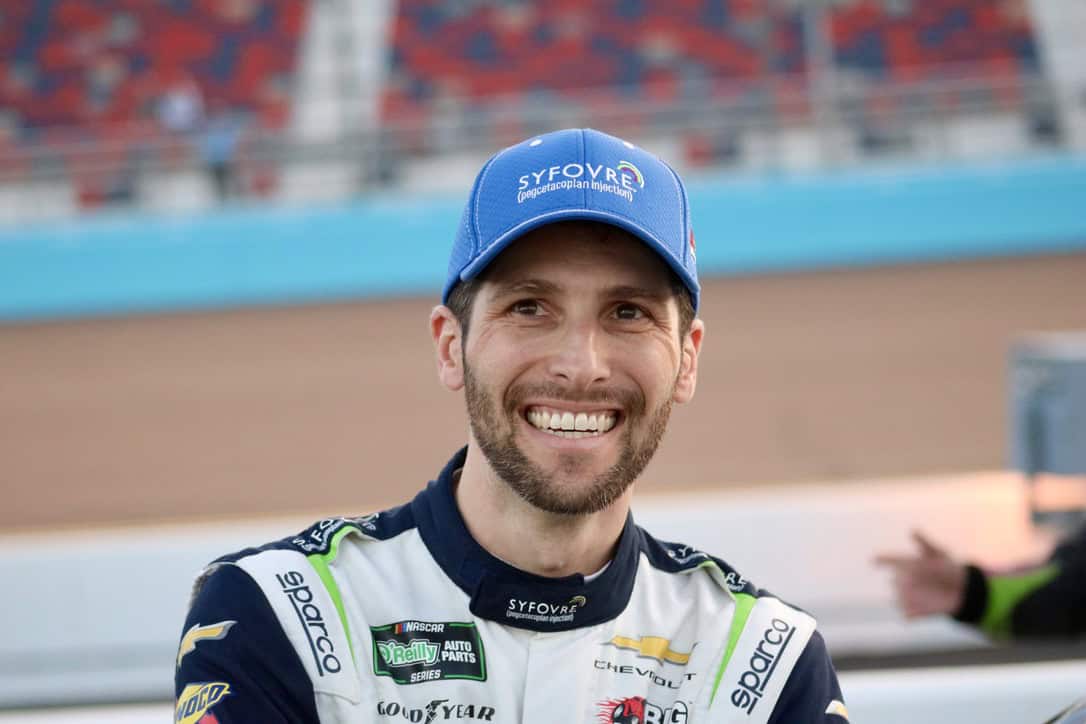
Back in 2013, Patrick Staropoli seemed well on his way to a career in NASCAR.
The Florida native won the PEAK Stock Car Dream Challenge, earning a development deal with Michael Waltrip Racing and a part-time K&N Pro Series Pro Series East and West (now the ARCA Menards Series East and West) ride with McAnally-Hilgemann Racing. He went on to win the West race at Irwindale Speedway in 2014.
But MWR closed its doors following the 2015 season, and with it went Staropoli’s NASCAR opportunity. He made a one-off start at Homestead-Miami Speedway in 2016 for SS GreenLight Racing before disappearing from the NASCAR scene for nearly a decade.,
In the meantime, Staropoli went back to medical school, becoming a vitreoretinal surgeon in Houston, Texas. Last year, Staropoli finally returned to racing at the national level, making starts in ARCA as well as the NASCAR O’Reilly Auto Parts and Craftsman Truck series. And now, he again puts his medical career on hold as he is competing in his first full-time season in NOAPS, driving for Big Machine Racing.
Staropoli spoke to Frontstretch about his return to racing, what he does as a surgeon and balancing the two. The video and podcast version of this interview were made available on Frontstretch the night of Wednesday, March 11.
Michael Massie, Frontstretch: You ran some races last year, but you’re a newcomer to the NASCAR O’Reilly Auto Parts Series. What’s it been like so far?
Patrick Staropoli: Man, it’s what I’ve been telling everyone. It’s been a dream come true to have this opportunity to compete full time in this series, drive for Big Machine Racing with the SYFOVRE Chevrolet. It’s what I’ve been working toward my entire life, my entire driving career to get a shot like this, and I’m just really excited to be out here. We’re kicking off the season strong.
Massie: What’s the atmosphere like at Big Machine Racing? I know you’ve raced for some other teams, but what’s this team like?
Staropoli: This team’s great. They’re intense. Everyone’s meticulous about what they do. Everyone’s passionate about putting the best possible product on the track, and it’s nice to be surrounded by a group of people like that that all want to go out there and perform as well and win as badly as I want to. It’s cool to be with a group full time.
Like you said, I’ve driven for multiple teams. I’ve kind of bounced around, different crew chiefs, different packages, like last year between the ARCA, Trucks and the O’Reilly cars. So being able to kind of hone in on one thing with one group of people has been really good.

Massie: Have you had much interaction with Scott Borchetta? He seems like a really interesting guy.
Staropoli: Yeah, definitely an interesting guy. I got to meet him in person for the first time last week at Daytona, but obviously we’ve talked a bunch over the last couple of months. I’m super appreciative to Scott for giving me this opportunity, for believing in me. He has a history of picking great race car drivers and artists, and I hope to follow suit in that direction and do really well with his No. 48 Chevy this year.
Massie: If you want a third career, you could get into the music, huh?
Staropoli: I don’t know if anyone wants to hear me sing.
Massie: Your crew chief Patrick Donahue’s been around. He strikes me as like the old school kind of crew chief. I’d say he’s underrated. What’s his style like as a crew chief?
Staropoli: Yeah, Donahue’s great, man. Anytime you have a chance to work with a Rainbow Warrior, I mean, it’s a cool deal. I grew up watching this sport and falling in love with it in the ’90s, when the No. 24 car (Jeff Gordon) was at its peak, and you could tell that Patrick took a lot of the lessons he learned back then working with Ray [Evernham] and applies them throughout the years, working with all of his different drivers and how he runs this team. It’s cool to be around it, to see his thought process.
Oftentimes before I’m even able to say what the car is doing, he’s either watching it on the track or when we’re simming, he can see it from the other room. He’s like, ‘This is what you feel, isn’t it?’ And he’s right every time. So having someone with that depth of experience for me to lean on, since I’m relatively inexperienced in these cars at this point, has been super helpful.
Massie: How did this deal come about? I feel like it came about like pretty late, like pretty close to the start of the year.
Staropoli: Yeah, one thing I’ve learned is that Silly Season is silly for a reason. To be honest, I don’t know how all the pieces fell together, but I know that I got a phone call from Scott and it’s an opportunity of a lifetime to get in this No. 48 car. And I obviously jumped on it as soon as I knew it was a possibility.
I didn’t know what the offseason would bring. Obviously, we had some strong races last year, and I was hoping that that would turn into a full-time opportunity, and fortunately, the stars aligned to make that happen.
Massie: Yeah, you kind of turned some heads in especially the ARCA starts. I think a lot of people were impressed by you, and then good finishes in Trucks and O’Reilly as well. Were you shocked to see that, yeah, still, I could hop back in?
Staropoli: Definitely, yeah, even though it’s been 10-plus years since I ran those K&N races [now ARCA] back in the day, I’ve tried to drive everything I could get my hands on in the meantime. So it’s been racing super late models — did a couple of SMART Modified Tour races, just hoping that one day I’d get a shot again on a national level. And when that came together last year, you have limited starts and you got to make them count.
The ARCA races, we had a look at a couple wins, didn’t quite get there, but we were close on a few. And then I think like the last race of the year that we ran it at Martinsville in the O’Reilly series was, was super strong and turned a lot of heads, and thankfully I had a lot of people on pit road come up to me after the race. And even though the result wasn’t there, the performance was, and taking something like that into the offseason, I think is what helped position us for this.
Massie: The two drivers previous to you in this car, Parker Kligerman and Nick Sanchez, they’re pretty popular with the fans, been around for a while. So how tough is it to fill those shoes, where it’s like a lot of fans might not know who you are yet and, you said yourself, not a lot of starts yet, so you’re trying to get there. How tough is it to fill those shoes?
Staropoli: Yeah, definitely both great race car drivers and a lot to learn from. And I think watching back tapes from the last several seasons of how this car’s performed, I’ve learned a lot just from even watching what they did on track. It’s cool to be in a position where you have an opportunity to be in a ride that runs up front and that performs well and you know that that potential is there and the equipment’s there and then the knowledge of the team.
So that was my whole goal this year, is just to kind of plug into Big Machine Racing, learn what they do, get in the seat and then execute on the level that they’re used to. It’s pressure, but it’s a welcome pressure. It’s something that you always want as a race car driver to be in a position to do that.

Massie: So let’s go back in time. You won the PEAK Stock Car Dream Challenge, the Michael Waltrip competition, and it seems like your career has taken off. What happened to kind of decide to give it up? Did you just choose to go into the medical field, or was it sponsorship dried up or what, what was the big thing?
Staropoli: Yeah, it was complicated, multiple factors. At that time, I did take a year off from medical school to go racing, because at that time, it was a once-in a-lifetime opportunity. I did win that K&N race out in Irwindale, which was huge. And I thought we were well positioned with Michael Waltrip Racing back in the day. Brett Moffitt was the other development driver. There was a general game plan and general path. Like everything in this sport, it goes up and down, sponsorship and opportunities. When MWR kind of ceased to exist at that point, that was sort of the end of that path for me, but I never gave up. So that’s a lesson to everybody out there, never give up on your dreams.
I went back, obviously, finished medical school. That became my full-time job, just raced on the side as much as I could and just never gave up on this happening.
Massie: So what led the comeback? You had to think that maybe like a full-time O’Reilly ride was maybe out of the question. Did you think that would never happen at that point?
Staropoli: Yeah, I mean, there were plenty of days. It’s 10 long years, hoping that you can make it back into one of these series. Every day when you’re working toward that, you’re asking people for whether it’s sponsorship or it’s a ride or funding or using kind of the friendships and connections that you have to try to get your foot back in the door. It’s a lot of no’s before that one yes, and all it takes is is that one yes and you go out there and perform, and that leads to more opportunities. It’s a long winding path, but it eventually led back here.
Massie: So don’t give up on your dreams and when they tell you no 100 times.
Staropoli: When they tell you no 100 times, the 101st time can be a yes. So keep digging.
Massie: So are you still practicing as an eye doctor, or are have you put that on hold?
Staropoli: So last year was balancing both, and that was a juggling act. This year, given the full-time schedule, we’re 16 weeks straight here to kick off the year, I’m taking a little bit of a sabbatical. So I’m pausing my practicing from now essentially through November, and I’m really thankful to all my partners at Retina Consultants of Texas out in Houston. We’re a big group. We share a lot of patients, and they’re kind of stepping up and helping me out this year while I’m taking some time off.
It’s cool though. My partners, all the patients out there have really rallied behind this. It’s nice to walk into a clinic day and have people talk about the racing that you did in the prior weekend. So it makes it fun. I am, obviously, missing my time out there, but I’m excited to get back in the fall.
Massie: Describe to me your medical profession.
Staropoli: I’m a vitreoretinal surgeon. It’s a big fancy word, basically just means that anything that goes wrong inside of an eye is what we fix. So people with retinal tears, detachments, diabetes can affect the eye very profoundly, people with trauma. Anything like that, I have been trained to take care of it.
One of the main things that we treat as well is macular degeneration, which is something that happens as you get older. What we’re doing with the SYFOVRE car is trying to raise some awareness for macular degeneration, and hopefully we’re going to accomplish that on a big level here.
Massie: Could you write me a prescription for my eyes while we’re here?
Staropoli: I got you covered after the interview. We’ll talk about it, yeah.
Massie: Which one is harder? Was medical school harder, or is competing in an O’Reilly race harder?
Staropoli: That’s a good question, man. They’re hard in their own ways. What’s unique about racing, or any professional sport, it’s competition. When you’re trying to take care of someone, you’re going to spend as much time as you need to and be as meticulous as you need to to do the best job possible. And when you’re out here, it’s about being as fast as possible, and you got 37 other people trying to do it faster than you. So you don’t really have that same sense of competition in medicine, but that doesn’t mean it’s any less difficult. So they’re challenging in their own ways. I’m a pretty competitive person, so I like that challenge. Definitely stepping up to the O’Reilly Auto Parts Series this year is a big leap, but a challenge that I’m ready for.
Massie: I hear from so many racecar drivers that they just got through school. Denny Hamlin jokes that they gave him a diploma to get him out of there basically. Because all these guys are so focused on racecars. How were you as a teenager able to still get good grades to be able to go to college and balance doing the racing on the side?
Staropoli: The deal with my parents and all my car owners, everyone I’ve driven for growing up was that I had to do good in school if I wanted to race, and I really wanted to race. So that was a big motivating factor for me. And then I think as the success started coming in school, I realized this is a path that I could follow. I could be the first person in my family to go to college. I can have like a different route in in life. And as many people want to become a racecar driver, professional in any sport, it’s difficult to make it there.
So I knew the chances of this happening, and I knew the chances that if I worked hard in school, there’s an endpoint that I could get to. So they were both motivating factors for me. I juggled them both for a very long time and will continue to do so.

Michael Massie joined Frontstretch in 2017 and has served as the Content Director since 2020.
Massie, a Richmond, Va., native, has covered NASCAR, IndyCar, SRX and the CARS Tour. Outside of motorsports, the Virginia Tech grad and Green Bay Packers minority owner can be seen cheering on his beloved Hokies and Packers.