
What Happened?
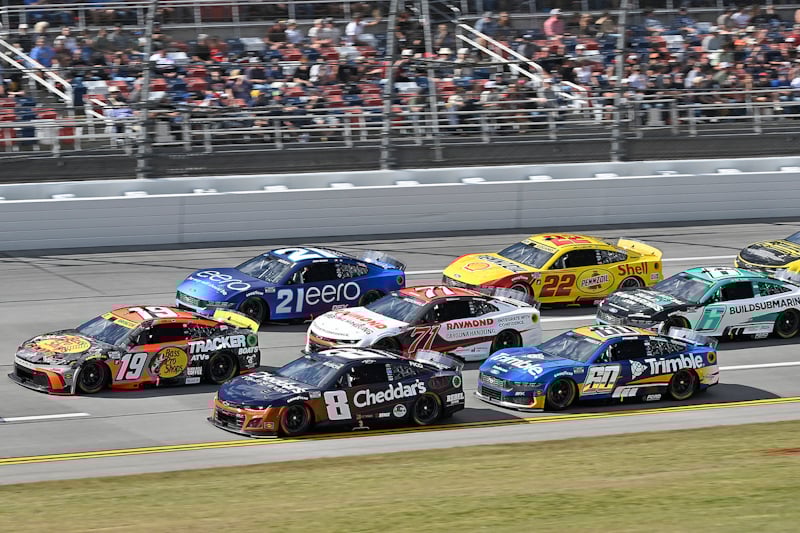
Chase Briscoe outdueled playoff rivals and fellow Toyotas alike to win at Talladega Superspeedway on Sunday, Oct. 19. Following behind him was Todd Gilliland, Ty Gibbs, Bubba Wallace and Cole Custer to round out the top five.
With his victory, Briscoe will join his Joe Gibbs Racing teammate Denny Hamlin to race for a NASCAR Cup Series championship at Phoenix Raceway in two weeks.
What Really Happened?
With 30 laps to go, I found myself slumped in my chair watching the final laps of Sunday’s 500-miler at Talladega. Keep in mind this happened as the field was three-abreast from the lead on back, all while listening to the radio scanner that was buzzing with constant spotter chatter. Yet the supposedly close competition didn’t stop me from doing something I probably haven’t done in all of my years of watching superspeedway racing.
I yawned.
Then, that caution with 23 laps to go came out, and when everybody came to pit road to top off on fuel for the rest of the event. From that point on, the field ran 100% throttle and I wasn’t yawning anymore.
Lead change after lead change, battle after battle, it seemed like the whole field came to life in perfectly orchestrated chaos. That’s what superspeedway racing used to be like. That’s what it’s supposed to be like.
I was glued to the screen once again and on the edge of my seat, not knowing who was going to win.
And to think, it was almost ruined by a fuel-saving race.
It’s a shame that superspeedway racing has become what is considered a dull affair for many NASCAR fans nowadays, but I can understand why.
Like you, I was bored of the constant fuel saving. Drivers pushing at only half-throttle for 40-50 laps at a time isn’t entertaining. While they are doing so at three, and sometimes four, abreast is certainly fascinating. But I will still die on the hill that it can be admittedly dull when there’s nothing at stake.
Sunday’s final 20 laps showed that this type of racing is fun. However, it feels wrong that we have to wait 171 laps and around three hours to be rewarded with a fun finish.
Does that mean the superspeedway races should be shortened? If that will fix fuel strategies, then, sure. I understand there is a tradition for 500 miles being run at Talladega no matter what. For the most part, I agree.
But what is more likely to be changed first? This brand-new racecar that NASCAR has invested millions of dollars of investment in? Or a hundred miles being taken off at Talladega?
Who Stood Out?
In all honesty, it’s pretty difficult to nail down one specific driver that stood out.
In fact, not one driver led more than 35 laps all day, and the one who led the most finished 16th. We’ll get to him — and a few others — later.
But perhaps a tip of the cap should be given to Kyle Busch. The No. 8 Chevrolet led 26 laps on Sunday afternoon. It was the first time Busch had led a lap since Kansas Speedway in May this year and the most laps he had led at Talladega since 2017.
It has been a rough year for Rowdy, who not long ago in 2023 was coming off of a three-race-winning season. Now, however, it seems KFB nation is looking for any signs of hope that Busch may one day win again. Sunday, for a moment, seemed to be that day.
Even on the final lap, while mired in traffic around 11th, the two-time champion received a huge push and tried to make a third lane on the outside. Alas, it didn’t work, and the No. 8 had to settle for 19th.
But make no mistake, today appeared to be a day the future Hall of Famer desperately needed.
Perhaps something similar could be said about the Front Row Motorsports organization or, more specifically, its driver Gilliland.
Both Gilliland and teammate Zane Smith were controlling the top two positions near the end of the race with only 10 laps to go.
Indeed, it appeared like shades of the 2013 spring race at Talladega when Gilliland’s father, David Gilliland, pushed FRM teammate David Ragan to the lead and win.
With the overtime restart, it didn’t work out as intended as neither driver won. That said, like 12 years ago, a Gilliland finished second.
It’s Gilliland’s best career result and only the second top five of his career.
Who Fell Flat?
Where to begin?
Originally, the Team Penske-aligned trio of Joey Logano, Ryan Blaney and Josh Berry were going to hold the weekly honor of being those that stood out on Sunday.
And for all intents and purposes, they did. Both Logano and Berry, who drives for the Wood Brothers, led a combined 62 laps around the Talladega circuit while Blaney led only three. Instead, Blaney was up front most of the race playing rear gunner for Logano.
Indeed, it looked like it was going to be every Logano hater’s nightmare scenario as the No. 22, for much of the event, was the favorite to win all the way down to the final 50 laps.
Berry’s hopes ended much earlier. The No. 21 had a mechanical issue shortly after the end of the second stage that forced him behind the wall. While he came out again three laps later, he returned to the garage for good with around 50 laps to go. Berry finished 33rd, continuing a miserable streak of results during this year’s postseason.
Despite Logano and Blaney’s late rally, it was not the day either one of them had hoped for, either. Logano, who was many points below the cut line heading into Sunday, missed out on both stages for points. Blaney, at least, was able to finish third in stage one and eighth in stage two.
The duo was at least in position to gather a great points haul late in the going when they held the top two spots. Unfortunately, shortly after the penultimate restart, both the Nos. 12 and 22 faded through the pack down into the 20s.
Upon the final caution inciting an overtime restart, they both had to pit to top off on fuel, driving them further down the standings with two laps to go.
In the end, Logano could only rally for a 16th-place finish while Blaney ended in 23rd. Both drivers face certain elimination at Martinsville next weekend barring a win.
The same could be said for two of the three remaining Hendrick Motorsports drivers. Chase Elliott wrecked out early in a multi-car crash in stage one and not only couldn’t gather any stage points but also was scored in last place. The 40th-place result was his lowest in the Cup Series since his part-time year in 2015, putting him a massive 62 points below the cut line and in a must-win situation for Martinsville.
Perhaps more heartbreaking was the plight of his teammates Kyle Larson and William Byron. Both HMS cars restarted on the front row for the overtime restart and in position to win themselves into the Championship 4. Alas, Larson ran out of gas on the backstretch while Byron was turned into the infield while coming to the checkered flag. Byron and Larson finished 25th and 26th, respectively.
Despite the unfortunate end, Larson still sits 36 points above the playoff cut line. The bad news is Byron is the one 36 points below it.
Paint Scheme of the Race
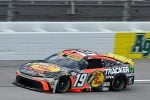
Busch Light has been putting out some great car designs over the last few years dating back to the waning years of Kevin Harvick‘s career.
This weekend with Ross Chastain was no different, but it’s still a shame that nobody could see it.
Jokes aside, camouflage has never been one of my favorite patterns. However, the orange-highlighted number and secondary color gives what is normally a dull and murky look a more vibrant design that makes it pop out a bit more.
Kind of defeats the purpose of camouflage, doesn’t it?
What’s Next?
The penultimate race of the season at one of the ultimate short tracks.
This year’s playoff Round of 8 comes to an end at Martinsville Speedway where all three of NASCAR’s national series will set their Championship 4 drivers.
Race 35 out of 36 for the Cup Series in 2025 will be broadcast live on NBC with coverage beginning at 2 p.m. ET on Sunday, Oct. 26.

Dalton Hopkins began writing for Frontstretch in April 2021. Currently, he is the lead writer for the weekly Thinkin' Out Loud column, co-host of the Frontstretch Happy Hour podcast, and one of our lead reporters. Beforehand, he wrote for IMSA shortly after graduating from Embry-Riddle Aeronautical University in 2019. Simultaneously, he also serves as a Captain in the US Army.
Follow Dalton on Twitter @PitLaneCPT
Easy fix, stop every 10 laps, take a 30 minute break for fuel, tires, change any parts and make adjustments. This should make the stupid happy, you know those who have no idea what a race is.
i was thinking about something similar…..have pit stop for fuel every 45 laps that didn’t count against lap total. that way everyone would have enough fuel.
a superspeedway race that came down to fuel mileage. typically there’s a wreck with 5-10 to go and they’re usually wrecking as the checkers comes out.
If you started watching after Brian inherited his new toy and attempted to “improve” his product you have not idea what a real “race” is unless you watch any other form of motor sports: drop the green flag and let it play out without the gimmicks.
i miss those days!
I do too. These days I never watch. More than the last 10 laps of RP races. It’s a waste of time
I haven’t watched a race this year. I do go back and watch the highlights and individual videos, but I really don’t miss watching the race. Never thought it would happen but I started hit and miss last year and found out I really don’t miss anything. And now I don’t gripe or get angry.. works for me.
Exactly
Sure, tapered spacer tracks have exciting endings, and this was no exception.
I agree with Mr. Hopkins here…why watch the rest of the race? I watched it on a delay, and wound up skipping most of it. I don’t watch to see wrecks, and who is running where matters little until the very end, so why waste the time?
I never thought I’d see the day, but NASCAR is finally reaching a point where I’m questioning why I spend time watching. Nearly every track is hurt by the current rules and structure.
If you want to keep the stages, at least stop throwing cautions when they end. NASCAR’s current system has some teams needing to chase stage points, hurting their attempt for the best overall finish. At tracks which allow pitting and remaining on the lead lap, teams which stay out for points regularly lose 10 – 20 positions in the running order, as everyone else pits before stage end, then cycles in front of them after the caution. The team strategy is sound. The system creating this incentive is madness.
Also, the mandatory cautions take some excitement out of the pit stops on tapered spacer tracks. Before mandatory cautions, you’d wind up with a few groups running, with the leading group running hard to try and keep other groups who had slower stops or other issues from bridging the gap to the main pack. It partially removed the incentive to just ride and save gas, because you didn’t know if another caution was coming. Better to run hard and hide than save fuel.
Dump the playoffs. Auto racing, and especially NASCAR racing has too much variability for this to work.
Use some sense when scheduling tracks. Take into account how the racing and attendance is impacted by temperature. As an example, few want to buy tickets to Martinsville when it may be 45 degrees and windy, and the race will likely be boring because the cars will be on rails due to low track temps, which also leads to decreased TV interest.
Anyhoo, off to shout at the clouds outside.
Agree with what you’re saying. On Martinsville, I only live about 10 mins from the track. Went to both races for about 30 years but when the date kept getting moved later and later in the fall and earlier in the spring, I stopped going. I got tired of freezing and the racing definitely suffered in the cooler weather. The fall race is now 2 months later than it was years ago. I’ll just watch on TV and skip through the commercials.
I’m farther away than that, but still not so far I couldn’t drive to and from in a day. I’ve been to around 30 races there over the years, but have no intention of returning. I may buy a pack of Jesse Jones hot dogs, make a pot of chili to make it a bit more authentic, and watch from home.
Chris Buescher was leading with just a couple of laps in the race when Willam Byron punted him out of the lead. I thought Byron was at fault, but on further review, it was NASCAR’s favorite ‘crash car’ driver, Carson Hoecevar who slammed into the back of the #24 and shoved Byron’s car into the back of the #17. It was pure luck that the #77 didn’t trigger ‘The Big One’, possibly taking out playoff drivers in the process.
This is a good example of why ‘Dega should not be a race in the playoffs.
The 77 knocked the 24 out on the last lap too. The 43 knocked out the 4 in a turn which is not a good idea.
Was anyone surprised when the 51 brought out a caution near the end of the event? I was expecting it closer to the end of the product.
This is a perfect example of why NA$CAR wants ‘Dega in the “playoffs” and why Daytona was a cut off event.
I agree, there was a TV montage that played during yesterday’s race hyping the brutal wrecks that have happened at ‘Dega. They think (correctly?) that fans like that kind of action.
The problem with having restricted engine races in, or near the playoff races allows shenanigans like Cody Ware’s timely ‘blown motor’ (how in the hell do you blow a plate engine?). Then there are other non-playoff drivers like Hoecevar (who admittedly had a fast car) who spent all race trying to ‘rattle the cages’ of cars in the lead pack. These things influence the integrity of the playoffs (if there really was any integrity the first place).
Watching Brian’s product should be like sex, where more than the last two minutes is the only time it is exciting.