
Lo and behold, the NASCAR Cup Series playoffs are upon us.
Because the commentariat never stops talking about the playoffs once the checkered flag of the Daytona 500 waves, we can all enjoy a moment of relief in reveling that we now know who has made the hallowed 16.
Sorry, Chris Buescher, your run to 10th in the points during the regular season means nothing, and you will now be relegated to being cannon fodder for those on a playoff quest.
A quick side note: our writers debated whether or not the season is a failure if one does not make the playoffs. But I couldn’t be bothered with contributing to that one because, 1) I’m so f&*^ing jazzed about the playoffs, and 2) short answer, total failure. A team might as well paint a big L on the windshield for the final 10 races to ensure that everyone recognizes their lamentable status.

While the existential debate rages on regarding the playoffs, with Joey Logano (who’s made a career at this point of playing the system, a la Jimmie Johnson) arguing for their continued livelihood, that discussion feels like an annual argument that feels as stale as a Cup Series schedule from 2018.
Maybe the question should be whether or not we should have a regular season at this point.
We’ve gotten to a point where even the regular season gets vilified for various reasons. Like, Chase Briscoe won at Pocono Raceway or something. His only win of the season. But there’s no track like Pocono during the playoffs, unless you count New Hampshire Motor Speedway – both tracks out there in the woods that people begrudgingly attend once a year.
Or there’s that Austin Cindric driver, who may or may not look like Briscoe, because who knows, and they’re not in victory circle enough to distinguish them by anything other than their firesuits. Anyway, he won at Talladega Superspeedway. Groovy. Crapshoot wins are definitely big for the Chase — err, playoffs.
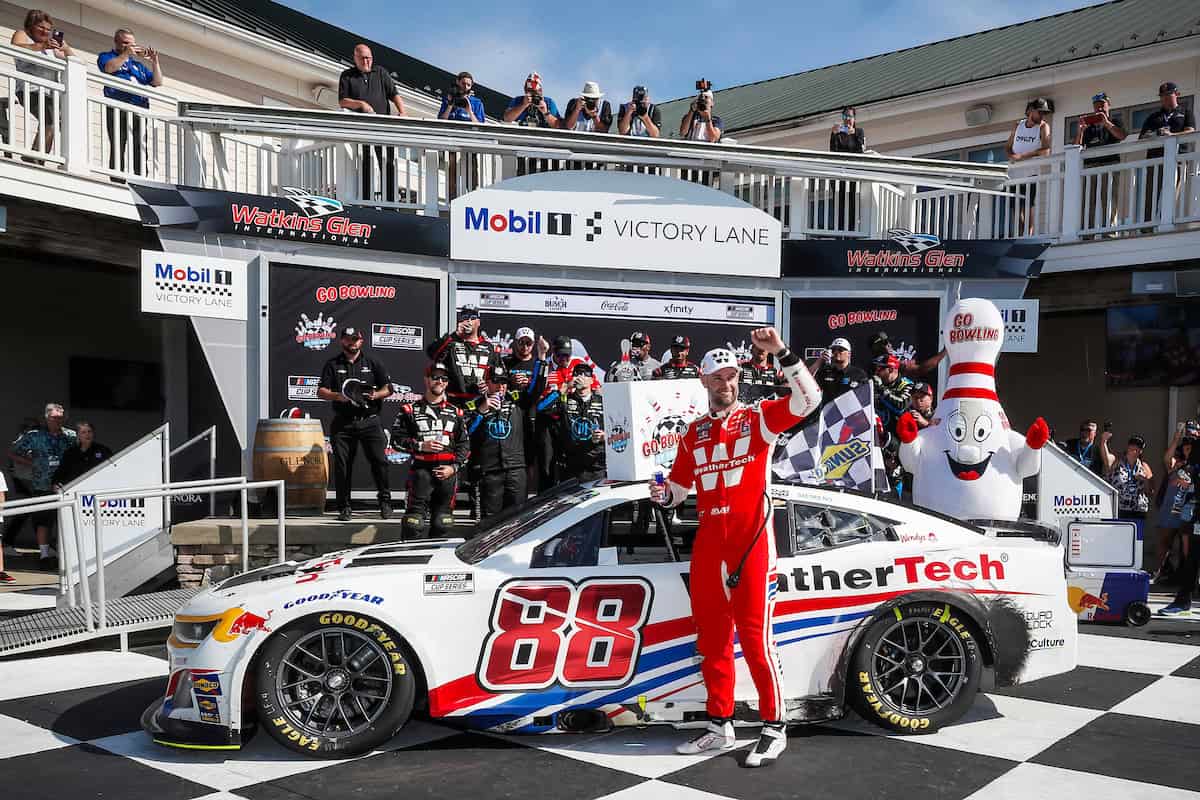
But if we’re going to shit on drivers snatching flukey wins that allow them to put a W on their windshield and drive without zero chance of making the playoff finales, then the derision toward Shane van Gisbergen feels real. Poor soul won only four road course races, which means nothing. See, there’s no point to the regular season!
The fact that last weekend’s race at Daytona drove its way into disaster by eliminating half of the field before the first stage break highlights the whole point.
How can we judge anything when even the cut-off race gets cut down by driver insanity in the first third? All of this is to remind ourselves that the whole thing is a contrived experiment in entertainment.
We did an exercise in my class this week to define sport(s) and filled the board. One of the comments we picked apart was the notion of entertainment. The challenge with entertainment is checking to ensure that the goods match the taste.
In NASCAR, anyone who follows the sport is aware of the generational divide and the perceptions that rest in that issue. This element brings a challenge to every sport and serves as a reminder that the next generation develops different sensibilities. Bridging these perspectives rarely goes smoothly. Let’s look at baseball, for example.

In the late 1800s/early 1900s, baseball held the public’s attention because of its unique sense of being American, while being the first sport to cement itself as a professional spectacle. One of its major selling points rested on speed. People considered the game to be fast. And in a time before HDTV, the theater of baseball appeared easy to follow as the distance between players allowed people to see the dramatic feats.
But as football made changes from its Flying V formations and opened up the passing game, it began to rival baseball’s spectacle. After WWII, baseball did not seem to be as fast as it had been before. Changes in modernity, faster air travel, the TV, the rotary phone, safer faster cars, shifted the ideology of speed. Baseball made attempts to remain entertaining, playing with the pitcher’s mound, using different colored balls at night at one point and toying with elements that could help sell the sport anew.
The advent of the pitching clock has been the one that has brought baseball toward the newer generation, one that digests the world in 30-second reels and constantly seeks a dopamine hit. The sport of NASCAR has been seeking its pitch clock ever since Matt Kenseth won only one race on his way to a championship back in 2003.
The playoffs were thought to be the pitch clock, but have not proven to be so.
Maybe shortening the races would work. Has that been discussed in focus groups? Don’t know. Those types of decisions are left to people who work within the sport and supposedly know more than I ever will.
The one surprise that got me, however, was how many of my students follow F1.
This trend continues to evince itself with one student even wearing Mercedes team gear to class. When I mentioned NASCAR in one of my classes, the vacant look said it all. But what do college kids know, right?


As a writer and editor, Ava anchors the Formula 1 coverage for the site, while working through many of its biggest columns. Ava earned a Masters in Sports Studies at UGA and a PhD in American Studies from UH-Mānoa. Her dissertation Chased Women, NASCAR Dads, and Southern Inhospitality: How NASCAR Exports The South is in the process of becoming a book.
I realize this article was written with the intent to provoke the reader, but there are a couple of things here of interest.
It’s no surprise at all that college students generally have no interest in NASCAR. (Before anyone jumps in here, there are absolutely exceptions to this.) NASCAR has always proudly touted itself as the big sport for blue collar fans. Additionally, the fan base at large generally makes zero effort to include outsiders, and if anything, some fans actively try to gate keep NASCAR as “their sport”.
Though I’m not a fan of the playoffs for other reasons, I don’t see the coverage as being much different than it was in years before the playoffs. The year Bill Elliott, Alan Kulwicki, and Davey Allison were vying for the title, essentially all coverage during the tail end of the season was dedicated to these three, and eventually paired down to Elliott vs. Kulwicki after Allison had issues in the final race.
As for NASCAR vs. F1, in a vacuum, it would make all the sense in the world for NASCAR to mimic nearly everything F1 has done over the past decade. But we do not live in a vacuum. Many NASCAR fans meet any changes with derision, because it’s not “the good old days”. And don’t get me started on how they rage if any race is held internationally.
So, NASCAR is painted into a bit of a box. Make changes to attract new fans? Lose your old fan base. Leave it all the same? Good luck trying to attract new fans. I’m a member of the older fan base, and would continue watching as I enjoy auto racing in most forms, but I am not typical of the demographic.
I become increasingly convinced NASCAR’s only path to increased interest is to take the bitter pill of losing much of the old fan base, becoming smaller for a short period of time, then emerging stronger with a new, more dynamic fan base later. But, for this to happen, NASCAR, TV, and car owners would have to make do with less money in the short term. And that’s probably not going to happen.
F1 kind of fascinates me (from a sociological viewpoint). The tech is incredible, the budgets nearly endless, but the racing is often not that entertaining (in my opinion). But it has a huge worldwide following, much like soccer, with passionate fans cheering for their home country. They seem to show up to be part of the show, not just to watch it. The American sports fan is obviously different. No less passionate (judging by fistfights at NFL games, lol), but less patient? Or perhaps less sophisticated?
The author pointed to baseball’s decline. NFL has been King of the Mountain for quite a while now. Why? Baseball, at it’s core, is a great game. Both teams have to face one another, an equal number of opportunities to defend or score. Man vs Man, the pitcher and batters must face each other, and by rules (strike zone), must give the opposing team a fair chance to put the ball into play. But it is slow. And there is strategy, although more subtle to those who aren’t avid fans. NFL, on the other hand, is play after play of fast motion, hard hits, and quick gains or fails. Still man vs man, but much more action on every single play.
Which brings me back to racing in America. NASCAR blew up on short bullrings that provided lap after lap of hard charging, near misses, bumps, spectacular saves, and astonishing crashes. It was action from green flag to checkers with the occasional break for caution. The decline started when tracks started to grow larger, the racing and drivers started being more “civilized” (thanks, Jeff Gordon! lol ), changes in the technology made the cars more aero-dependent (harder to pass) and the rowdy, rough and tumble action of days passed gave way to lap after lap of conveyor belt racing and little passing. There’s still strategy, and yes it still takes skill to wheel the cars at speed, but to the American fan it is just not enough action to keep them engaged.
Perhaps it is simply a reflection of how Americans live their lives vs the rest of the world? We’re amped up on coffee, nicotine, and Redbull (or whatever the energy drink of the day is) going here, running there, doing, doing, doing. Bigger, Faster, Better. Constantly. Whereas most of the world is less hard charging and more laid back. More in-tune with tradition and interpersonal connections, and thus, less dependent on constant stimulation.
Maybe therein lies part of the problem with NASCAR growing internationally? NASCAR is 100% American, and to the rest of the world, has no roots or significant traditions (in their markets). No personal connection. Thus, they are less likely to be “wowed” or interested. Not to mention, NASCAR doesn’t have cars they are interested in, no “home team” to cheer for. Perhaps a driver could be local, but as F1 shows, it seems the international fan is more attached to the team/manufacturer (country of make, tradition) as opposed to the driver.
Really well put. I always enjoy reading your insights.
I suspect there would be a market for NASCAR internationally, if the stir amongst international fans from running a modified Cup car at the 24 hours of Le Mans was any indication. Reports were it was hugely popular due to the earth shattering sound of a Cup engine. Gearheads like power, whether it’s the old F1 engines screaming at 20k RPM, or a growling V8 torque monster like NASCAR deploys. And really, many Mercedes AMGs of the past decade have sounded more like Cup cars than F1 cars.
Baseball kinda lost me when advanced analytics took over. I get the “why” behind nearly always swinging for the fences, but something was lost vs. a star pitcher sweating because he just knew Rickey Henderson was about to swipe yet another base as soon as he delivered the pitch, or whether Vince Coleman was about to lay down a bunt and leave a smoke trail headed to first. It’s just not as much fun when the vast majority of batters are looking to either hit the ball a mile, or strike out trying. Again, the strategy is sound, it just removed much of the drama from baseball. Earl Weaver was right all along…two bloops and a blast.
Although many US sports fans aren’t sophisticated, (looking at you, Philly football fans,) I don’t think the US overall is much different than international crowds. British soccer hooligans are no more sophisticated than the Philly fans who pelted Santa Claus. And US fans will show up in droves for tennis, which is obviously a sport which caters to sophisticated fans.
I completely agree about attention spans, though again, I don’t know that the US is a real outlier here. It’s nice to tune into an F1 race, and know the event will generally play out in 2 hours or less. We are the ones insisting on four hour racing odysseys every week.
I know F1 drivers don’t like the Saturday sprint races, but as a fan, I very much enjoy them, and I wish NASCAR would adopt something similar. Sprint race the day before the primary race with reduced points and purse, remove stages from both, and slightly shorten the main event the next day.
Keep a few races at the longer length, obviously the Daytona 500 and Charlotte 600, and shorten the rest to cut the fat from the races. I’d much rather watch a 100 lap Bristol sprint followed by a 300 lap main event the next day than a 400 lap main event with no sprint race. Again though, many “old school” fans would hate it, because “change bad”.
As I enjoy reading yours. I appreciate that you keep me honest with well thought out counterpoints when appropriate.
I recall seeing the SCCA event in Houston back in 2013 prior to the Indycar race (unfortunately, the last race for Dario), and those Cadillac CTS-V machines sounded amazing. I’ve been a V8 fan since a kid, and those were impressive.
As for shortened races, I agree. Back in the day, longer races brought attrition through mechanical failures into the game, but today everything is manufactured so well that things just don’t break. The drivers train, eat, and hydrate so much better too, which means less human fatigue as a factor. I think there’s still a place for endurance racing like LeMans and such, but the weekly 500 mile grind may be too much. As you mentioned, attention spans… One of the things I really like about Indycar is I can watch the full replay after work in 2 to 2.5 hours (skipping pre and post race coverage). The 500 is of course different, but that’s another part of what makes it special.
Glad I’m not the only one who nearly always skips pre and post race. Unless there’s some sort of big story, it just seems like fluff to me.
I was interested to read that the viewership for Daytona, the final race before the ‘playoffs with at least 2 or 3 drivers in line to get in or out depending on the finish…was down from last year. This could mean several things. The crapshoot of a Daytona win isn’t that compelling. That viewers aren’t that interested in the whole idea of a playoff. No one cares who makes it, because the eventual champion is mostly a ‘win one race’ proposition. Maybe the fact that wins are so unpredictable at Daytona kept the interest low. Who knows. But this ‘game seven’ moment doesn’t seem to be as compelling as Nascar wants it to be.
Not a fan of shorter races. It stinks that Bristol and Martinsville have been reduced to 400 laps. F1 is neat, but its too short for me as well.
Perhaps we should move Daytona back to July 4th weekend. Or at least swap Richmond. Richmond as the last race was pretty good, almost always filled with real drama instead of wreck-fests.
F1 real races are an hour and a half long usually without a break. When was the last time Brian’s product lasted an hour and a half without a caution for a driver scratching an itch on his arm?
Alex clinched the IndyCar real championship with two races to go. They have to change the scoring to TRY to eliminate that ever happening again.
Might want to check on the history of the playoffs before writing an article on the subject.