
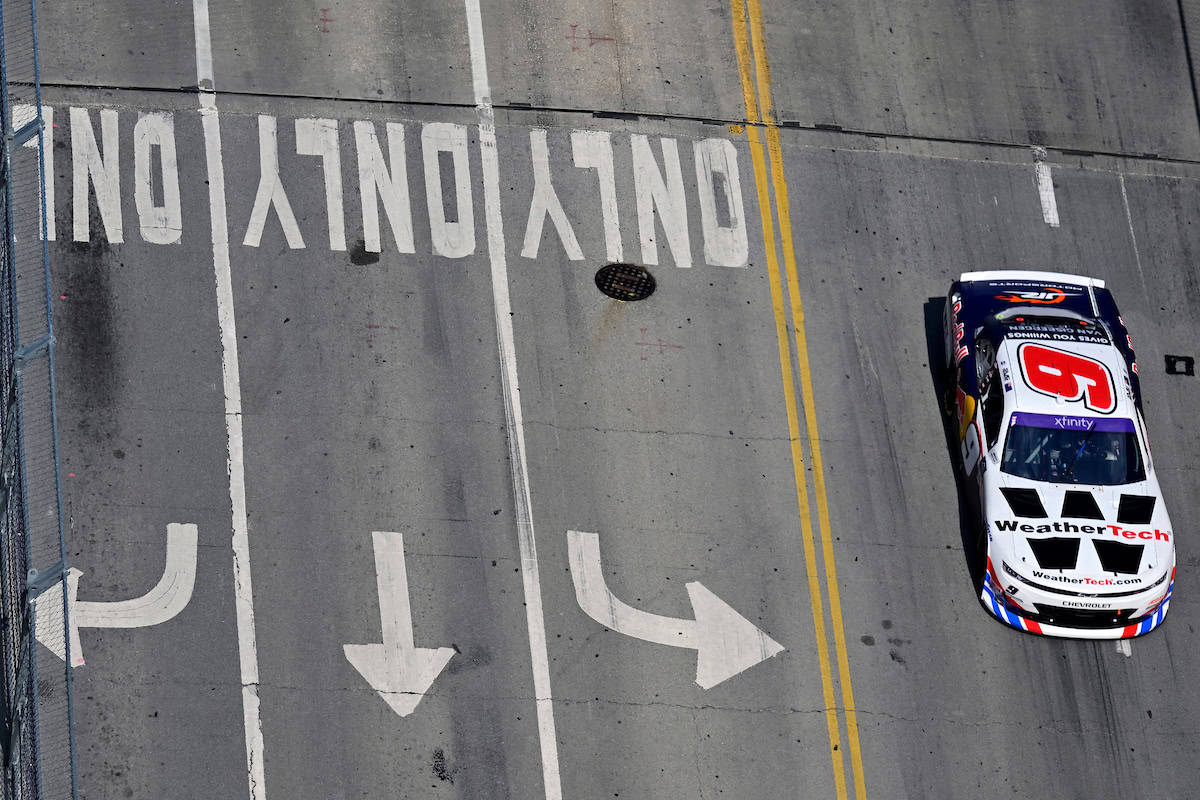
NASCAR’s top two divisions tackled the streets of Chicago for the third time on July 5-6. It could also be the last time — at least for the foreseeable future. The original plan orchestrated by NASCAR and the city of Chicago called for three race weekends, held on a new temporary course that ran through Grant Park in the heart of the city. The races were first announced in July 2022, nearly a year before the inaugural event.
In that time, the concept of a Chicago street race was met with pushback from the city’s leaders, some of whom claimed to have been uninvolved in the negotiations and criticized the race as a bad deal for the city. Many of Chicago’s residents reacted with resistance as well, questioning the wisdom of shutting down major roads in the heart of the city around Independence Day weekend. Even NASCAR’s more traditional fans, (your author included), were skeptical about the quality of racing that bulky, lumbering stock cars would provide on narrow city streets with tight corners. NASCAR, however, forged ahead despite the doubts. The sanctioning body relished the opportunity to bring stock car racing directly to the people of a major American city.
To give NASCAR credit, the Chicago Street Race worked as a proof of concept. Despite unfavorable weather and logistical challenges, the sanctioning body demonstrated that there is viability in a stock car street race. That is not to say that the quality of racing on the Chicago course was always great, or that street racing should become a major part of NASCAR’s repertoire. What the race provided was stunning visuals, an engaging technical challenge for the drivers, and a level of accessibility to a city that no other track in NASCAR can truly match. In those respects, the sanctioning body accomplished its goal.
However, if you want to measure the success of the Chicago Street Race by how much it won over the locals, the picture is less rosy. The city’s leaders have been noncommittal to renewing their deal with NASCAR. If the sport was going to return to Chicago in 2026 and beyond, you would think that — based on the timing of the original announcement — a deal would have to come together soon. Instead, there have been persistent rumors that NASCAR is talking with other cities about potential street races, with San Diego at the top of the list. Another rumor, via Carson Hocevar over a live stream, is that NASCAR is returning to Chicagoland Speedway next year. None of these rumors have been confirmed by NASCAR, yet their spread indicates that the future of the Chicago Street Race is foggy at best.
More broadly, the rumors suggest that NASCAR does not consider the Chicago Street Race a permanent solution for getting its brand of racing in front of locals in a major city. It is certainly not a new challenge for NASCAR, whose style of racing was nurtured and still primarily embraced by rural America. Even during the sport’s boom years in the 2000s, the sanctioning body tried desperately to build a track on Staten Island in New York City, but fierce local resistance doomed the project from the start. Street racing offers the advantage of creating a track without building a track, giving NASCAR a gateway into Chicago 20 years later. Yet if the locals have not enjoyed what they have seen, it could make the Windy City’s Street Race a short-lived experiment.
If the street race does not return, NASCAR has the option to follow through on the Hocevar rumor and go back to Chicagoland. It would not be a bad option; Chicagoland hosted the NASCAR Cup Series for nearly 20 years and has all the infrastructure necessary to handle a large crowd.
The question is, how large of a crowd would show up? The track struggled with attendance in recent years, including a run of seven straight seasons where it opened the playoffs. Fans also criticized Chicagoland for a lack of compelling racing, being too similar to the other 1.5-mile tracks on the schedule, and how its location in Joliet was too far away from Chicago. The street race was supposed to fix all those problems by giving Chicagoans a unique race in the heart of the city that would excite the fans. NASCAR could pursue a return to Chicagoland if it wants, but the only real advantage in doing so would be maintaining a foothold in the Chicago market. A presence near the city might be worth it to the sanctioning body, but that’s uncertain for now.
Note that NASCAR was willing to step away from the Los Angeles market completely, at least for 2025. The preseason Cook Out Clash moved from the Los Angeles Memorial Coliseum to Bowman Gray Stadium, ending a three-year run that saw local interest decline with each season. The LA version of the Clash feels a lot like what could happen to the Chicago Street Race: a unique event that worked as a proof of concept, but one that ran out of steam once the novelty wore off. Facing an opportunity to bring the Clash to one of NASCAR’s ancestral tracks, and the uncertainty surrounding the former Auto Club Speedway site, NASCAR determined that staying in LA just to be in LA was not worth considering another option.
Perhaps a street race in San Diego can get NASCAR back to Southern California. Such an event would help expose stock car racing to a city where drag racing and road racing have traditionally reigned supreme. It would also sidestep the issue of NASCAR having to build another racetrack in Southern California, where the value of land makes no venue sacred.
On the other hand, NASCAR has not proved that street racing works as a long-term solution for any city. Suppose NASCAR holds a San Diego street race for three years, but then the novelty wears off again and the race does not return for 2029. Will the sanctioning body have a more permanent solution for Southern California by that time? Does the sport completely exit the market again? Maybe NASCAR is content to rotate a Cup Series street race to a different city every few years. While that would help introduce the sport to new audiences, would a lack of permanence for the event even create a dedicated fan base?
NASCAR deserves credit for experimenting with street racing in Chicago. The event undoubtedly worked better as a concept than a lot of people would have predicted. Yet it feels like NASCAR is still confusing popularity in major markets with being physically located in major markets. There is certainly value in the experience of visiting a city and watching a stock car race from the heart of downtown. But if the sport’s leadership is trying to use street racing as a mechanism for creating committed fans in the biggest cities of the United States, simply putting the race directly in the city for a few years has not proven to be an effective strategy on its own. More research is needed, in 2026 and beyond.
Good article. I understand that sponsors enjoy the Chicago Street Race. It also lets the teams and sport get before other potential major sponsors who would probably not bother showing up at a race in Joliet.
However, NASCAR let it slip recently that the Chicago Street Race has been a significant money loser for them due to the expensive logistics and staging costs. How much longer NASCAR is willing to keep subsidizing this race is unknown.
Can’t be any more expensive than trucking down to Mexico City.
It doesn’t matter where they go NA$CAR will tell everyone they are saving the teams money.
Maybe try Japan again? Or Australia again?
I like it. Adapt or die. Unless NASCAR grows, matter of time before FIA creates a competing series and relegates NASCAR to the series for drivers who can’t cut it at the top tier, as Indycar is to F1.
Ouch, that’s harsh! I’m not sold on F1 being the pinnacle for open wheel drivers. For car technology and engineering, yes. Doesn’t mean they’re not talented, because they are! But I’m not sure they are the absolute best out there when the car makes such a significant impact to the driver’s success (or lack of).
Anyway, we already have the truck series for drivers who can’t cut it at the top tier. ;-)
(Thumbs up for a great reply, even if I don’t quite agree.)
Don’t get me wrong. I still find what Indycar drivers do rather remarkable. They are amazing in their own right, but I still feel as a group, they are not on par with elite F1 drivers. Also agree equipment makes a larger impact in F1. Max Verstappen seems to be the only driver capable of wrestling a mid-tier car to compete above where others could put it.
I still enjoy Indycar, and there are a couple of drivers who may have been able to transition over. (Dixon when young, Palou now. I don’t buy into the Herta hype, though I still think he’s elite in Indycar.)
Still, Hauger is decimating everyone in IndyNXT, while he was good but not great in F2. He likely will be the next superstar in Indycar, whereas he would have been lucky to secure even a bottom tier F1 seat.
O’Ward is considered among the elite few in IndyCar, yet wasn’t considered good enough to be given a shot in either of Mclaren’s F1 seats.
There are multiple drivers in Indycar who either washed out of F1 itself, or FIA feeder series. The opposite is generally not true.
That’s not to say all F1 drivers are better than all Indy drivers. Both series have drivers who are only there due to money or connections. Stroll in F1 comes to mind here.
It’s telling that every top tier open wheel driver aspires to F1, and the elite often get there. Indy is just a nice consolation prize for those who aren’t quite at that level. Now, if drivers like Hauger keep migrating over, they very well may raise the bar for everyone else, closing that gap a bit.
I still wonder what transpired to keep Palou in Indycar. Was Chip that persuasive, or did he see something at McLaren he didn’t like that gave him pause? If anyone recently in Indycar has (had) a shot at F1, it has to be Palou.
I wondered the same back then. Possibly knowing he’d be a big fish in a comparatively small pond, vs. the blender that is F1?
Also, the boys in Papaya Orange were in a fair amount of disarray back then. I wonder if he regrets it now, seeing how dominant their equipment they’ve become.
Justin Marks (Trackhouse Racing) and NASCAR had no problem exploiting Daniel Suarez leading up to the race in Mexico City. Marks knew he was going to fire Suarez, but waited to drop the hammer on the hometown hero until after the event there.
NASCAR is chasing a targeted audience and a major market that doesn’t exist and never will.
Get more road courses and Nascar can get rid of more ovals thus saving money. The heck with the fans who have support them for so many years.
I get the marketing desire to bring your product to dense population bases (more eyes and $), but the reality is city folk are generally not interested in auto racing. At least, that has been my experience.
I grew up in rural America, and have lived in both Suburban (never downtown in a city center) as well as rural areas as an adult. The rural areas have always had more racing fans (and specifically, more NASCAR fans). My opinion, cars in rural areas are seen as a gateway to freedom, fun, and new adventures. Cars in the city/burbs are simply an appliance, and generally considered a nuisance. The city/suburb view above has become even more prevalent in the last 20 years. Nobody likes to drive in the city, and the city kids don’t even want a driver’s license (much less a car) when they’re teens – because driving in a city/suburb is a horrible, dreadful, miserable, life-draining experience. And that’s before you even try to find that open $50 parking spot blocks away from where you want to be.
It should be obvious where I prefer to live. lol Others love the city, and that’s great – different strokes for different folks, it’s just not for me.
To wrap up my rambling, I know there’s still car culture to some degree in the cities, but it’s a small niche. Even then, what I have seen is more of a tuner crowd (performance-wise) and artful customizations. They are certainly not into NASCAR racing.
When you see on the news that 50 people have been shot in the same city on the same weekend that Nascar is in town, there’s probably not going to be a huge rush of people from out of town heading to the city on race day.