
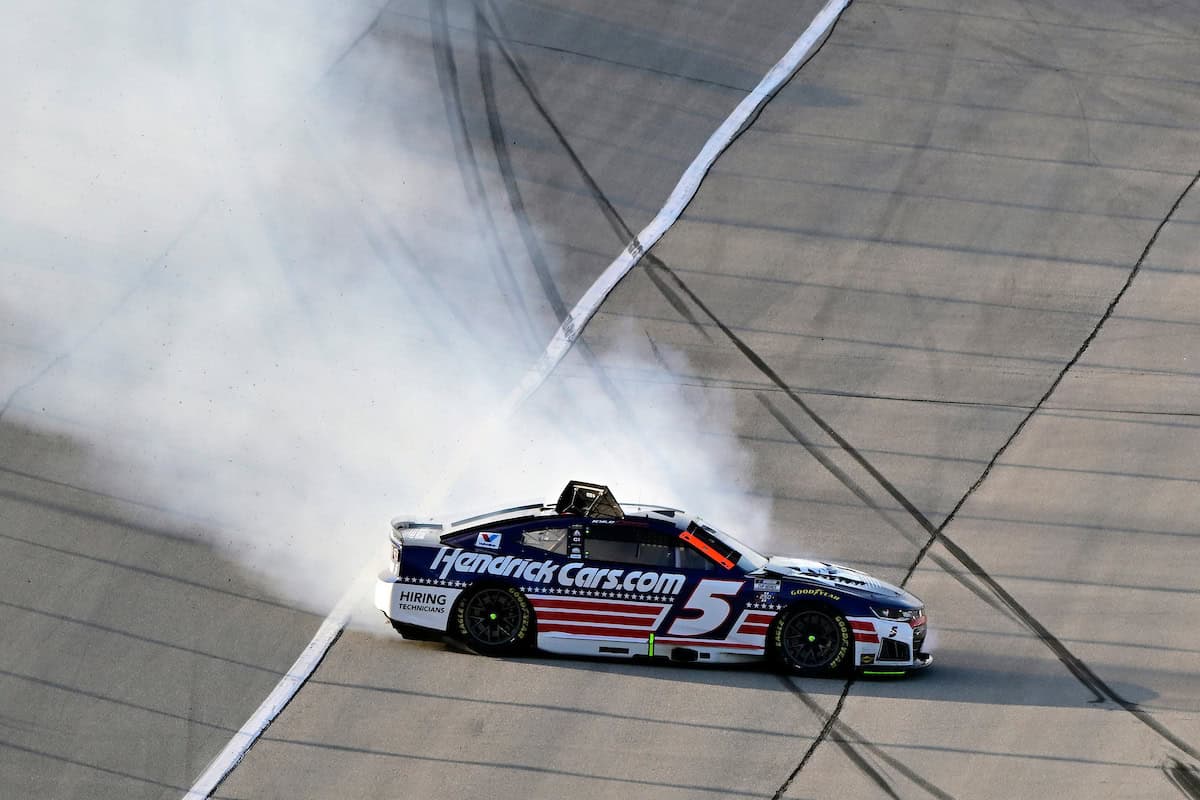
Kyle Larson was running third during stage two in Sunday’s (July 5) eero 400 at Chicagoland Speedway, but one simple spin out of turn 4 into the infield grass was enough to ruin the rest of his race.
It had rained heavily in the two days prior to the Cup Series race, so Larson’s No. 5 getting beached in the mud isn’t an indictment on the Next Gen car. With how muddy it was, any generation of Cup car would’ve gotten stuck the way Larson did if it had the misfortune of landing there.

The most annoying part of the ordeal for Larson, however, came after he received the tow out of the grass, as his car was still immobilized on pavement by virtue of the car’s flat tires. He received a brief push to get his car moving and then had to make the long crawl of shame around the racetrack, all while the diffuser and underbody of the car were scraping against the pavement.
What looked like a promising chance for Larson to end his 42-race winless streak in Cup instead ended with a 34th-place finish, two laps down.
“When I got out of the grass and had a flat, I knew I was kind of f***ed from there and just dragged the bottom of the car off and then had no downforce for the rest of the day,” Larson said after the race.
“I mean, obviously I made a mistake, it’s my mess, that’s just the crappy part about this car and you get a flat. It just ruins your day.”
It’s year five of the Next Gen car, and we’re still seeing cars get stuck with flat tires, just as they did in year one.
Thankfully, we’re well beyond the days of Josh Berry getting parked on lap 1 at Kansas Speedway in 2024 because he was unable to drive away from a multi-car crash with flat tires, as the damaged vehicle policy was changed for 2025 to prevent that from happening again.
But between the damage taken to the underbody of the car and the sheer amount of time it takes to retrieve a car with flat tires and tow/push it back to pit road or the garage, spins that would’ve been harmless in previous generations still have the potential to be catastrophic for the Next Gen.
But there is a fix to this, and we’ve already seen it in action before. That’s what makes it all the more frustrating.
In August 2024, NASCAR gave Cup teams the option to install a rear damper which would allow safety crews to lift the car by a few inches in the event of flat tires so that a car would be able to drive away without getting stuck.
Casey Mears got stuck with flats after a spin in his Daytona 500 Duel in February, but he was able to drive back after the safety crews lifted the car.
Mears’ car having that system proved to be crucial. He lost a lap from the ordeal, but if he had to be towed or pushed back, he almost certainly would’ve gone two or more laps down. A late caution in the Duel allowed Mears to get back on the lead lap, and he successfully navigated through a last-lap crash to gain enough spots and qualify for this year’s Daytona 500.
If he was stuck multiple laps down without the lift system, that miraculous turn of events never happens.
But therein lies the problem with this system: it’s not a requirement.
If you’re a race team, you’re focused on the performance of the car first and foremost. If installing the system brings a disadvantage performance-wise, the benefits of not using it typically outweigh the times a team would need it. After all, when was the last time Larson got stuck from a spin before Sunday? When was the last time any car got stuck from a spin? Neither of those are questions I can answer off the top of my head.
But if the system was a requirement, no team would be at an advantage or disadvantage based on their choice of opting in or out. And the mandate of such a system would not only be a benefit to the teams at the misfortune of getting stuck, but also a benefit to the fans that won’t see their favorite drivers wiped out of contention.
Not to mention that such a change would do wonders to improve the overall viewing experience. The length of cautions is a sore spot in NASCAR today, and not having to tow or push cars back would expedite the amount of time needed to pace under yellow, allowing fans to see more green flag racing.
Plus, it’s year five of this car. Such a problem shouldn’t still be an issue nearly half a decade later. Let’s put this issue to bed once and for all.


Stephen Stumpf is the NASCAR Content Director for Frontstretch and is a three-year veteran of the site. His weekly column is “Stat Sheet,” and he formerly wrote "4 Burning Questions" for three years. He also writes commentaries, contributes to podcasts, edits articles and is frequently at the track for on-site coverage.
Find Stephen on Twitter @stephen_stumpf
Thanks for choosing to comment on this article. A name and email address are required to post a comment. The email address is not publicly visible or shared. Please keep in mind that comments are moderated according to our comment policy.