
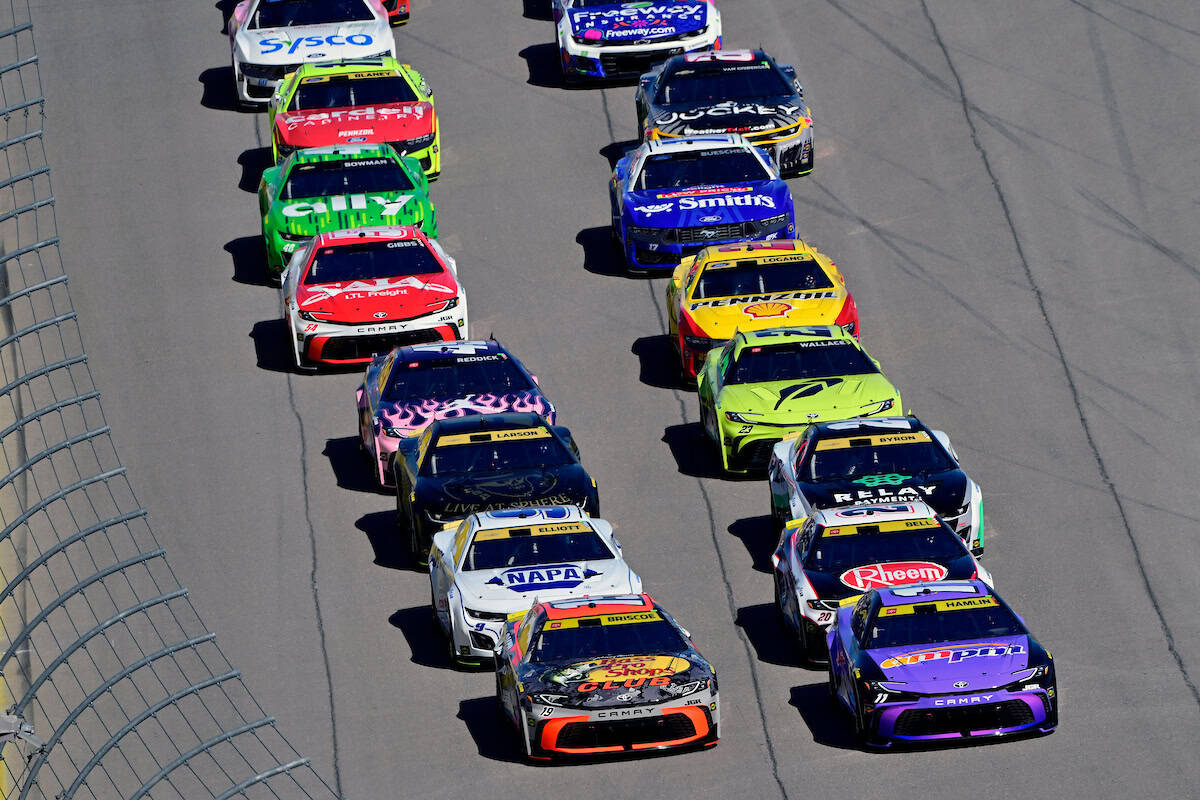
Sunday’s (Oct. 12) South Point 400 at Las Vegas Motor Speedway marked the start of the Round of 8. Usually, this is where the playoff focus on broadcasts eases up a little and you can see a more complete picture of the race. That’s what we had last year.
Unfortunately, Sunday’s broadcast was not that. You had a heavy focus on the eight playoff contenders from the start of the race.
I rewatched Countdown to Green Monday morning and realized that there were actually more interviews before the race than I thought. Regardless, it was still almost completely focused on the playoffs. There was no real notion given of what we were going to see on Sunday in the race.
The focus was on the playoff contenders from the very start of the race and never really let up. It was irritating to know that if you weren’t in the playoffs, you had to do a lot to get much of a mention on the broadcast. Tyler Reddick did plenty to get his mentions since he was mixing it up with the leaders for much of the event.
Then, there’s what happened with William Byron and Ty Dillon late in the race. Yes, that got Dillon some TV time, but definitely not how he would have liked to get it.
This is effectively how NBC Sports started its coverage of the incident. Why? The broadcast was showing a replay of Byron nearly wiping out exiting turn 2 a few laps earlier. That slip had cost Byron the lead to Kyle Larson.
Obviously, we’re talking about a pretty scary wreck here. Had this crash occurred in darn near any other form of motorsports, Byron’s car would have been sent flying, possibly into the catchfence.
The broadcast had quotes from Byron’s radio right away that indicated that he had no clue that Dillon was pitting, which was helpful for viewers. The infield care center interviews revealed two different stories. Byron more or less stuck to his story from the radio.
Meanwhile, Dillon indicated that he shouldn’t have to signal if his spotter was doing his job notifying the other spotters of his intention to pit. This whole explanation sounds ridiculous.
At the speeds they’re running at Las Vegas these days, you have to throw a bone to your competitors, especially if you’re running laps down. If there’s something that you can control, do it.
Once the broadcast got to the crash, the coverage was top notch and covered it properly. This was not a garden-variety crash and it got the attention that it deserved.
There were other aspects of the broadcast that were a little weird. For instance, the broadcasters were convinced that Joey Logano had a tire coming apart at one point due to a weird noise on his in-car camera. It was never really followed up on.
Granted, seeing as this was in stage two after Ryan Blaney had his tire failure, the announcers were on high alert. Speaking of Blaney, his crash occurred right as the broadcast came back from a commercial. It seemed obvious that it was a left-front issue, but it was stated as a right-front failure. That’s a whoopsies.
One of the main reasons why the focus on the broadcast was so heavy on the playoff drivers is that there really wasn’t all that much movement Sunday. There were a couple of drivers (Brad Keselowski and Kyle Busch, in particular) who were able to move forward, but a lot of drivers just stayed where they were for most of the race.
Seven of the eight playoff drivers started in the top 10 and stayed there for the vast majority of the race. Blaney had to fight from behind and made very little progress before the blown tire put him out.
A lot of the passing on Sunday came as a result of the pit sequences under green. Drivers such as Bubba Wallace and Chase Elliott, who got penalized early on, had a heck of a time moving forward afterward. Wallace ended up 22nd while Elliott was 18th.
Post-race coverage was not as complete as what we had at the Charlotte Motor Speedway ROVAL. Viewers heard from a half-dozen playoff contenders, checked the points and got some post-race analysis before NBC Sports left Las Vegas.
Overall, the playoff focus was far too high in Las Vegas on Sunday. I’m not really sure how good the racing was away from the restarts because of this focus. If it wasn’t that swell, perhaps that’s an explanation for the tactics.
If the race isn’t that exciting, there are other strategies that can be used in order to be more inclusive in coverage (they did a Through the Field, but it was only about playoff drivers and got cut off when Byron nearly binned it). Luckily, next week is far easier.
That’s all for this week. Next weekend is going to be a big one. NASCAR has a tripleheader at Talladega Superspeedway, where all kinds of shenanigans could go down. Or you could get a race like the last time the NASCAR Xfinity Series raced there in the fall, where the wackiness was kept to a minimum. Formula 1 will be at Circuit of the Americas in Texas, while SRO America will wrap up its season at the Indianapolis Motor Speedway. TV listings can be found here.
We will have a critique of Sunday’s YellaWood 500 from Talladega in next week’s edition of Couch Potato Tuesday at Frontstretch. Also, note that all three Talladega races will be on over-the-air broadcast TV, including Friday afternoon’s Truck race.
If you have a gripe with me or just want to say something about my critique, feel free to post in the comments below. Even though I can’t always respond, I do read your comments. Also, if you want to “like” me on Facebook or follow me on Twitter, please click on the appropriate icons. If you would like to contact either of NASCAR’s media partners, click on either of the links below.
As always, if you choose to contact a network by email, do so in a courteous manner. Network representatives are far more likely to respond to emails that ask questions politely rather than emails full of rants and vitriol.


Phil Allaway has three primary roles at Frontstretch. He's the manager of the Frontstretch email newsletter that publishes Monday-Friday and occasionally on weekends. He keeps TV broadcasters honest with weekly editions of Couch Potato Tuesday and serves as the Frontstretch Sports Car racing editor.
Outside of Frontstretch, Phil is the press officer for Lebanon Valley Speedway in West Lebanon, N.Y. He covers all the action on the high-banked dirt track from regular DIRTcar Modified racing to occasional visits from touring series such as the Super DIRTcar Series.
Agree there was a ton of coverage of playoff drivers, but as far as I could tell via the ticker, there was also very little happening back in the field. Vegas (along with most of the cookie cutter ovals) is usually a boring race, and this one was no different. Given NASCAR coverage always gravitates to the front, it makes sense they gave playoff drivers so much focus.
Though I wish coverage was more inclusive of back markers, that never seems to be the case with NASCAR, playoffs or not. There are always stories somewhere, whether it be what was wrong with Ty Dillon’s car all day before the wreck, or other cars struggling to compete. I don’t understand why NASCAR coverage doesn’t mimic F1 here. F1 coverage will investigate and note car issues, whether it’s first place or last place. I get NASCAR fields are nearly twice the size of F1 fields, but NASCAR races are also much longer, allowing plenty of time to keep up with the details.
As for the Dillon/Byron wreck, it would be interesting to know how the communication really played out. Sure, Dillon should’ve waved, but as some have noted, with the sun low in the sky, it’s entirely possible Byron never would have seen it anyway.
I don’t like the Dillons any more than most, but I do think dislike for them coupled with superstar bias has people jumping to conclusions. Depending upon what happened with communications leading up to the wreck, fault could be on Dillon alone, it could be on Dillon’s spotter, it could be on Byron’s spotter, or even Byron himself.
“Vegas (along with most of the cookie cutter ovals) is usually a boring race”
Wait, I thought the consensus is this car is better on 1.5 mile ovals and that’s it?
That’s the consensus, but for me it doesn’t change these tracks are not enjoyable to watch, especially with stage cautions removing most tire/fuel strategy and management.
It seems this car is slightly better on the 1.5 mile ovals than the prior gen car, but it still doesn’t make for interesting races. The cookie cutters are inherently boring to me. Other than restarts, little tends to happen, and there’s not much a driver can do to improve running position.
I’d rather watch road courses or smaller ovals (other than Richmond) any day. Much more the driver can do to help/hurt their own cause, rather than the engineering competitions the 1.5 mile tracks tend to be.
i don’t like all the screen splitting. oh well season almost over.
dega up next. we’ve been in a drought here in the south, and the forecast for sunday is 75% chance of rain. too early to be accurate. but should throw a wrench into the works.
I also am planning a motorcycle ride to the NC Mountains. Monsoon time!
Hopefully not for you!
Be safe! Gorgeous down that way.
I found the coverage of this race painful to watch. Broadcasters act like at any moment the race ends and that is when points count. The “this means one point” comments are ridiculous (in my opinion). There was also at least one moment when Diffey talked about a car that wasn’t even shown on the broadcast at the time. I “ditto” the comment here about F1. It appears to me that every driver is mentioned at some point. NASCAR yes, more cars but that’s a poor excuse because there is clearly enough time.
I think the broadcasters work with what they are given. You call the race in front of you and they do the best with what they have to work with.
I have nearly stopped watching. Outcomes are predictable. I have Martinsville tickets, but not feeling it.
I hear the hype of the car-mile-half track garbage, but I sat through the first 510 miles of the 600 and it was a parade. If it were not for stage breaks, Byron or Larson would have won by 8 laps.
It is dull and predictable. It’s not on the broadcast team – it is the horrible racing.
And while I am on it, I read about cars on the lead lap, blah, blah, blah. Really, stage breaks and wave around.
Give me a break.
Product is broken.
With four races to go in the season, the focus has ALWAYS been on the drivers still in the hunt for the championship, from the 80’s to now that the races have been on TV. This is not news.
Agree, and I honestly can’t figure out where this line of thinking comes from. This easily predates the playoffs.
As you and I both have noted in the past, one only has to jump over to YouTube and watch a classic race from late in the season. The coverage always gravitated to the Cup contenders.
And really, by this point in the season, it makes sense. The Cup is the biggest prize of the year, so it’s only natural it will receive a large amount of air time as the season winds down. I’d like to see more coverage down the field, as there’s time for both. The two aren’t mutually exclusive.
A lot more cars and sponsors got mentioned in the 80’s. There wasn’t the concentrated coverage of select owner and drivers who pay for it. Drivers weren’t ignored because they didn’t have a chance at the real deserved championship.
I think you’re looking thru rose-colored glasses. Many races in the 80’s had a lot of attrition and fewer drivers on the lead lap than today. They didn’t get mentioned.
There are more cars finishing events now. Out of the 36 or 30 who usually start Brian’s product, how many get mentioned? Why would cars who are out of the event get mentioned, unless they drive for Reverend Joe or Mr. H? J-Jo.’s car got shown when it was in the trailer after wrecking out of the event.
Agree. In the 80’s, there were roughly 10 – 15 drivers who regularly got coverage, and therefore their sponsors got air time.
Guys like O.J. McDuffie, Ronnie Thomas, Buddy Arrington and really the majority of every field were seldom mentioned, and if their sponsors got air time, it was because a big name happened to be passing or lapping them.