
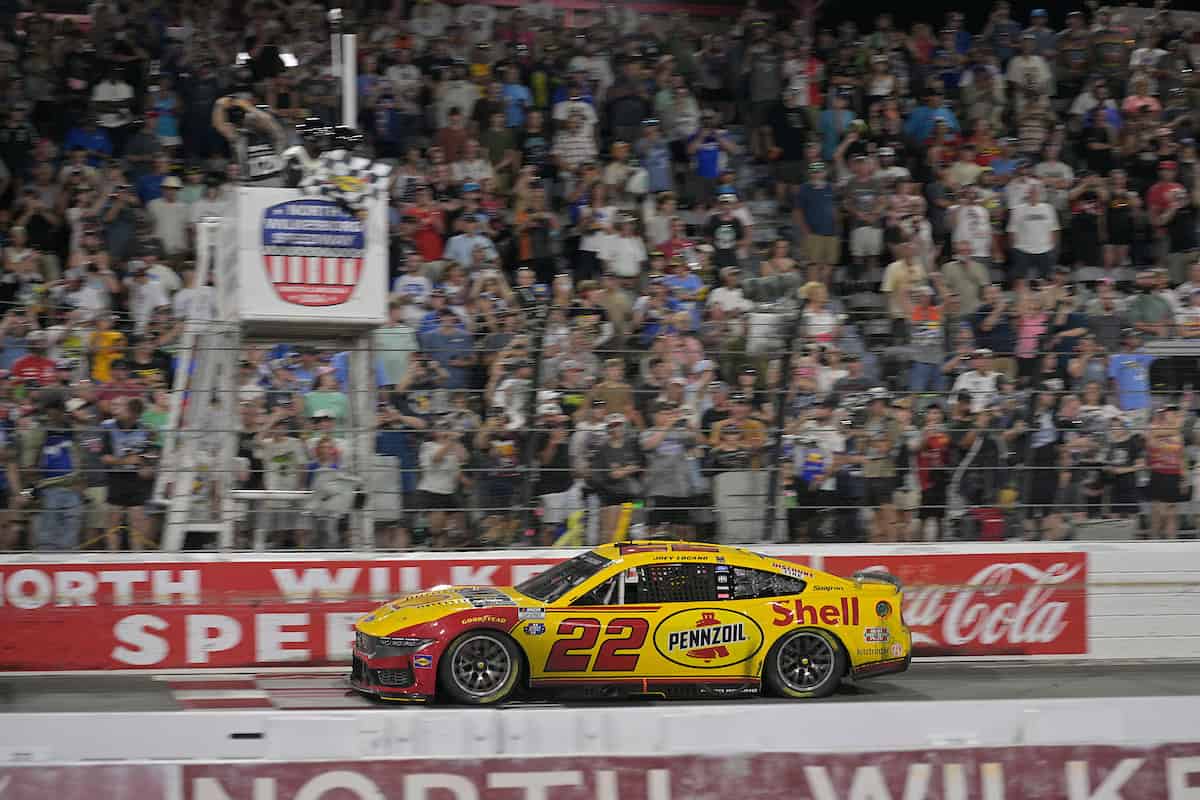
Should NASCAR have kept North Wilkesboro as a points-paying race?
As was feared, the 2027 NASCAR Cup Series All-Star Race is slated to return to North Wilkesboro Speedway in May after just one year of the track hosting a points-paying Cup race.
The fan reaction to the announcement was, as one would expect, poor at best and pissed at worst. After the track hosted one of the best short track races on the schedule in front of a sold-out crowd, it is now relegated to be, in NASCAR’s own words, a test track for the Cup Series.
It’s great that the track is keeping a date, but for fans in that area and those watching at home, having that race mean something for The Chase and the regular-season standings added another element of the track being fully back to its former glory.
Rockingham Speedway is now caught up in the ongoing IHRA debacle and was the only other vintage track that looked like it had real momentum behind it as it worked toward a return to the schedule. Now, with North Wilkesboro relegated to being a one-off and the Rock more than likely being put up for sale yet again soon, the great momentum that both facilities were building has been stopped in its tracks.
NASCAR has done a far better job this year in listening to both the fans of the sport and its teams, but this one is a head-scratcher. I hypothesized in the last column that NASCAR could be releasing its new schedule in smaller bits and pieces to soften some blows, and that appears to be exactly the case thus far, with moves ranging from moving the July 4 weekend to Iowa Speedway to now shuttering North Wilkesboro’s hopes for another points race in 2027.
There is still plenty of good on the 2027 schedule, such as the Clash moving back to Daytona International Speedway, but with that good are a lot of questionable decisions — and the full schedule still hasn’t been released yet, either.
Should Corey Heim be allowed to compete for Rookie of the Year in 2027?
In the grand scheme of stock car racing, NASCAR’s Rookie of the Year award might not look like much, but the powers that be within the sport gave some intriguing insight into the Rookie of the Year requirements on the Hauler Talk podcast this week by making it clear that Corey Heim will not be eligible for the award during his first full-time Cup season next year.
According to NASCAR, the minimum number of starts a driver can make and still be considered a rookie is 12. Heim has made 15 and won two of them. Technically, then, those two wins are the most out of any first-year Cup driver at the moment. Notice I didn’t say rookie because, apparently, to be considered a rookie, Heim would have needed to apply to NASCAR, which he did not do. Instead, he’s just a first-year driver.

Makes total sense, right?
I understand that rules are in place for a reason, but when we have to distinguish between a rookie and a first-year driver, we’ve lost the plot. Just slap the yellow stickers across his bumper and call it a day. There are, what, a maximum of 3-4 rookies each year in the Cup Series? That’s a small enough number to take each on a case-by-case basis, as far as I’m concerned.
From the way Hauler Talk‘s Mike Forde explained it on the podcast, it sounds like these are relatively new rules regarding rookie classification in NASCAR, considering several drivers currently in the field made well over 15 starts before their rookie seasons. If that’s the case, so be it, but we’re worried about litigating the wrong thing here.
With Lowe’s, M&M’s and Dodge all making their way back to NASCAR, who could be next?
NASCAR is a sport marked by iconic sponsor pairings: Richard Petty and STP, Dale Earnhardt Jr. and Budweiser, Jimmie Johnson and Lowe’s and Kyle Busch and Mars Candy, the latter two of which are reportedly making a return to NASCAR in the coming months. Lowe’s looks to be partnering with Johnson for one more run in the Daytona 500, and M&M’s will return to a Joe Gibbs Racing Toyota at Bristol Motor Speedway later this year in honor of Busch, who died earlier this season.
Dodge is even planning to make a Cup entry as soon as next year, per reports, marking another longtime partner’s return to NASCAR’s biggest stage.
From a sponsorship standpoint, it feels as though the stars are aligning to bring some much-needed revenue back into NASCAR.
So who could be next to bring an iconic logo back to the Cup Series? I know who I want: Caterpillar and Molson Coors Beverage Company.
I grew up in the small town of Corinth, Miss., with a massive Caterpillar plant just next door. If my friends’ parents didn’t work for the local power company, the next best guess was that they were employed by Caterpillar, which meant that most of them supported whatever driver had one of the great CAT schemes across the car.
The local plant would give away diecast models of CAT schemes as promotional materials, and I tried to get my hands on as many of them as I could.
When it comes to Molson Coors, how could you not like the iconic Silver Bullet schemes or the classic Miller High Life/Bobby Allison pairing? Anyone who pays attention to the alcohol industry right now knows that it’s been tough sledding; people simply aren’t drinking as much as they used to. But a good marketing play can tend to help those numbers, and going back to their roots is never a bad strategy.
Could NASCAR borrow some character from the Knoxville Nationals?
For those who aren’t as tuned in to the dirt-racing world, the annual Knoxville Nationals are this week and will run into the weekend. This is the biggest weekend for sprint car racing in the country, and Kyle Larson will make trips to and from Knoxville Raceway and Richmond Raceway this weekend just to enter.
While the track in Knoxville, Iowa, is the country’s premier sprint-car venue, the race itself has an identity like no other. It feels like NASCAR used to. The entire town shifts its focus to the racetrack for the weekend and pitches in, with several local businesses offering free breakfasts, talks with upper management at both the track and the sport’s biggest sanctioning bodies, big-wheel races for kids and the whole nine yards of fan engagement.
Any time you try to copy another race’s identity, it rarely goes as planned. However, racing has always been — and always will be — a copycat’s game. What’s stopping NASCAR from throwing a random driver footrace into the mix every once in a while?
There are plenty of races on NASCAR’s schedule that do have their own identity. As someone who grew up going to Talladega Superspeedway every year, never touch the spring race. But there are still the 1.5-mile tracks on the schedule to consider which could offer so much more in terms of fanfare and uniqueness. For instance, Las Vegas is adjacent to a city with more personality than it knows what to do with. There’s no reason that race should be anywhere close to boring.
If some of the cookie-cutter, market-filling tracks just had an ounce of the character around them that Knoxville Nationals does, it would take those venues from being another blip on the schedule to something fans around the country want to travel for.


Tanner Marlar is a staff writer for Sports Illustrated’s OnSI Network, a contributor for multiple automotive news outlets, an award-winning sports columnist and talk show host, and a PhD. student at a premier college of media and mass communication. Tanner began working with Frontstretch in 2022, covering the O'Reilly Auto Parts Series.